What a paraphrasing tool does
Paraphrasing tools and AI humanizers both take text in and give different text back, so it is fair to ask whether the distinction is just marketing. It is not, quite. They start from different goals, and the goal decides what the tool changes and what it leaves alone.
A paraphrasing tool is built to say the same thing in different words. Its job is done when the wording no longer matches the original. It works mostly at the level of words and phrases: synonyms, reordered clauses, active swapped for passive. That is useful when you need to restate a source in your own words, simplify a dense passage, or avoid repeating yourself.
The same sentence, two results
A humanizer is built to change how the text reads, not just which words it uses. Its target is the pattern that makes machine-written prose feel flat: sentences of similar length, stock transitions, generic phrasing and an even, unchanging tone. So it works at the level of sentences and paragraphs. It will shorten one sentence and lengthen the next, drop a filler opener entirely, and replace a formal connector with nothing at all.
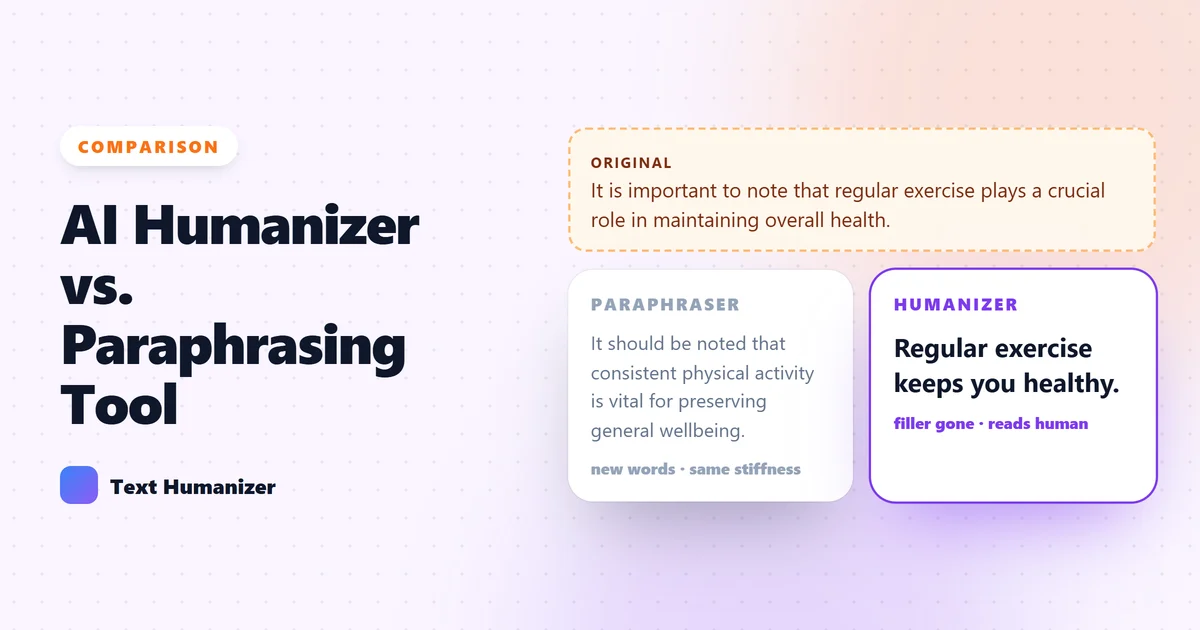
You can see the difference on one sentence. Take "It is important to note that regular exercise plays a crucial role in maintaining overall health." A paraphraser might return "It should be noted that consistent physical activity is vital for preserving general wellbeing." Every word changed, and it reads exactly as stiff as before. A humanizer is more likely to return "Regular exercise keeps you healthy." Fewer words changed in spirit, but the filler is gone and it sounds like a person.
Which one your draft needs
Neither tool changes your facts, and neither should. If the output says something your original did not, that is an error to fix, not a feature. This is why a diff view matters: you should be able to see exactly what was removed and added, and put back anything that shifted the meaning.
Which one do you need? If the problem is that your wording is too close to a source, or too complicated for your audience, you want paraphrasing, plus a citation if the ideas are not yours. If the problem is that the draft is correct but reads like a template, you want humanizing. And if the only problem is typos and agreement errors, you want neither: a grammar checker fixes mistakes without touching your style.
A note on what these tools are not. Rewording someone else's work does not make it yours; ideas need attribution however the sentences are arranged. And no rewriting tool can promise how a particular checker, teacher or editor will judge the result. The honest use of both is the same: start from your own ideas or properly cited sources, and use the tool to make the writing clearer and more natural.
Try the Free AI Humanizer
See the difference genuine humanizing makes — paste any AI text and get natural, human-sounding writing back.
Humanize My TextKeep reading
6 min read
12 Words and Phrases That Make Writing Sound AI-Generated (and What to Write Instead)
A working list of the phrases readers have learned to associate with AI text, why each one grates, and a plainer alternative for every entry.
6 min read
Using AI for School and Work Writing: A Practical Guide to Doing It Honestly
AI can speed up drafting without replacing your thinking. A plain guide to what is generally fine, what is not, and how to check the rules that apply to you.