Openers and connectors
None of the phrases below is wrong. People wrote all of them long before language models existed. The problem is frequency: models reach for them constantly, so readers have started to treat them as a signature. If a draft contains several, it will read as generated even if you wrote every word. Here are twelve worth searching for, grouped by the job they are trying to do.
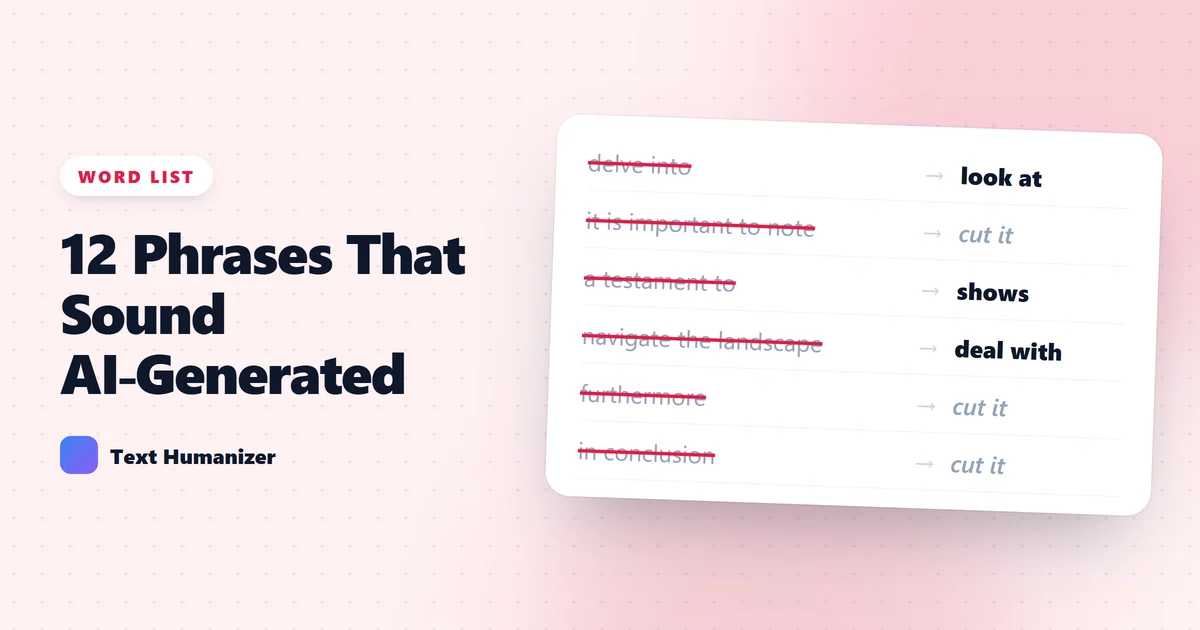
Openers that delay the point. (1) "It is important to note that": delete it and start with the thing that is important. (2) "In today's fast-paced world": it sets no scene and could open any article; start with your actual subject. (3) "When it comes to": replace "When it comes to pricing, clarity matters" with "Clear pricing matters". (4) "It is worth noting that": if it is worth noting, note it.
Worn-out metaphors and labelled endings
Connectors that announce structure. (5) "Furthermore" and (6) "Moreover": usually removable with no loss; if the second sentence builds on the first, the reader can tell. (7) "Additionally": try "also", placed mid-sentence, or simply start the next sentence. (8) "On the other hand": fine once, when you are truly contrasting two things; "but" does the same job in one word.
Metaphors that have worn out. (9) "Delve into": write "look at", "explain" or "examine". (10) "Navigate the landscape of": name the real action, such as "choose between" or "deal with". (11) "A testament to": say what it shows. "The launch is a testament to the team's work" becomes "The launch shows how hard the team worked".
Why these phrases, and how far to go
Endings that announce themselves. (12) "In conclusion" or "In summary": readers can see that it is the last paragraph. Cut the label and make the final sentence carry something new: the recommendation, the consequence, or what to do next.
Why these and not others? They share two traits. Each is a safe, formal, all-purpose choice, which is exactly what a system trained to predict the most likely next words will prefer. And each can be removed without changing the meaning of the sentence, which tells you it was never doing much work.
Do not over-correct. Stripping every transition makes writing choppy, and replacing each phrase with a fancier synonym just moves the problem. The goal is not to avoid a banned list. It is to make each sentence start at its point and use the plainest words that are accurate. If a "however" is the clearest way to mark a real turn in the argument, keep it.
A quick way to audit a draft: paste it into a tool that highlights these phrases as you type, count them, and fix the paragraph with the most first. Then read the piece aloud. Any sentence you would never say to a colleague is a candidate for rewriting, whether or not it is on this list.
Try the Free AI Humanizer
See the difference genuine humanizing makes — paste any AI text and get natural, human-sounding writing back.
Humanize My TextKeep reading
6 min read
Using AI for School and Work Writing: A Practical Guide to Doing It Honestly
AI can speed up drafting without replacing your thinking. A plain guide to what is generally fine, what is not, and how to check the rules that apply to you.
5 min read
Why AI Writing Sounds Robotic (And How to Actually Fix It)
AI can draft a paragraph in seconds, but readers can usually tell. Here's the actual reason AI text feels stiff — and what fixing it really requires.