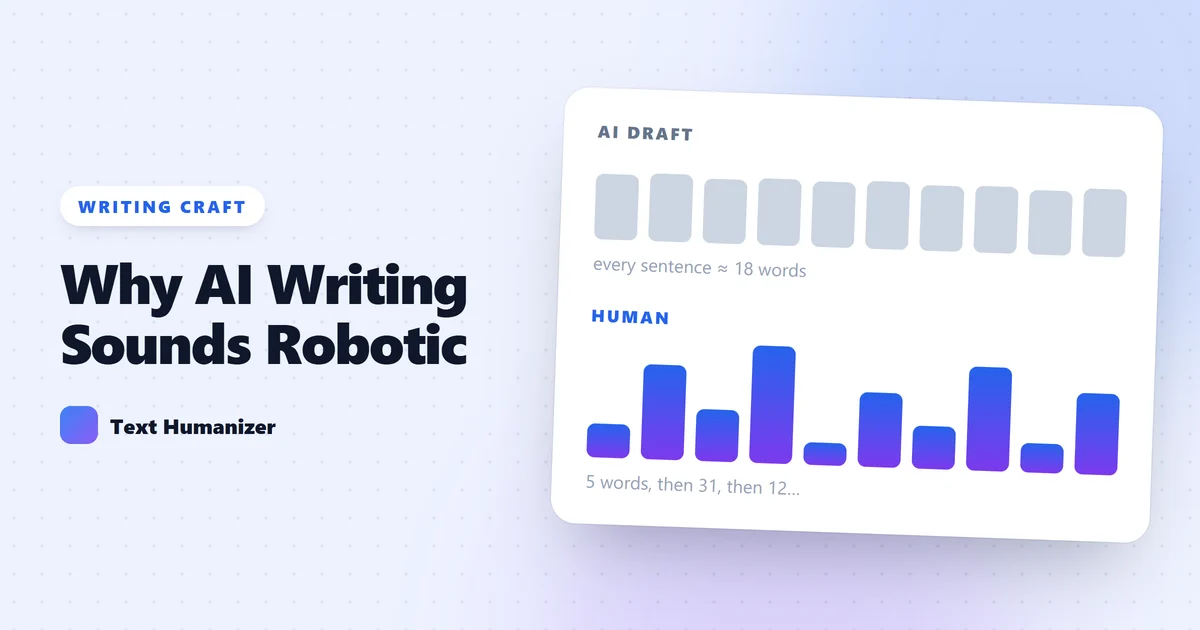
Paste any AI-generated paragraph next to something a person wrote off the cuff, and most readers will guess correctly which is which within a sentence or two. It is not that the AI version is wrong — grammatically it is often flawless. It is that it is too even. Every sentence lands at a similar length. Every paragraph builds the same way: setup, elaboration, tidy conclusion. Nothing surprises you.
That evenness is not an accident of bad prompting. It is a direct consequence of how large language models are trained. They are optimized to predict the most statistically likely next word given everything that came before. Predictable is exactly what they are built to be. A human writer, by contrast, brings mood, memory, and a dozen small biases to every sentence — which is precisely what makes real writing feel alive and occasionally uneven in a way that reads as authentic rather than sloppy.
What detectors are actually measuring
Detectors and human readers key in on the same signals, just at different levels of sophistication. Researchers call the two main ones perplexity and burstiness. Perplexity measures how surprising a given word choice is — AI text tends to pick the safest, most expected word almost every time, which produces low perplexity. Burstiness measures variation in sentence length and complexity across a passage — human writing swings between short, blunt sentences and long, winding ones, while AI drifts toward a comfortable middle length and stays there.
There is a third signal that is more about vocabulary than structure: AI models have favorite words and phrases. "Delve," "moreover," "it is important to note," "navigate the landscape of" — these show up constantly in AI output because they are statistically safe transitions, not because any particular writer favors them. When five different tools all reach for "delve into" in the same paragraph, that is not coincidence. It is the fingerprint of the training data.
What genuinely fixes it
So what actually fixes this? Not a thesaurus pass. Swapping "important" for "significant" does not touch sentence rhythm or remove the underlying evenness — it just relocates the same statistical safety to a different word. Real humanizing means rewriting for variation: letting some sentences run long and complex, then cutting hard with something short. It means picking a word because it is the specific, slightly unusual choice a person with an actual point of view would make, not the safest one.
The most reliable results come from combining a genuine rewrite pass — one that targets sentence rhythm and cuts formulaic phrasing — with something no model can fake: a real detail only you would know. A specific anecdote, an actual opinion, a concrete number from your own experience. That layer is what turns "technically human-sounding" into writing that actually reads like a person, because it is.
If you are staring at an AI draft right now trying to decide how much to change, start with the phrases. Cut every "furthermore," "in conclusion," and "it is worth noting" you can find — they add nothing and they are the single easiest tell to catch. Then look at your sentence lengths. If three sentences in a row are all roughly the same size, break the rhythm. Do those two things by hand and you will already be most of the way to text that reads like it came from someone, not something.
Try the Free AI Humanizer
See the difference genuine humanizing makes — paste any AI text and get natural, human-sounding writing back.
Humanize My TextKeep reading
4 min read
7 AI Writing Habits That Give You Away Instantly
Certain phrases and patterns show up in AI writing so often they have become dead giveaways. Here is the full list, and why each one happens.
6 min read
How AI Detectors Actually Work (And Why None of Them Are Perfect)
GPTZero, Turnitin, Copyleaks — they all claim to spot AI text, but the underlying method is more statistical guesswork than certainty. Here is what is actually happening.