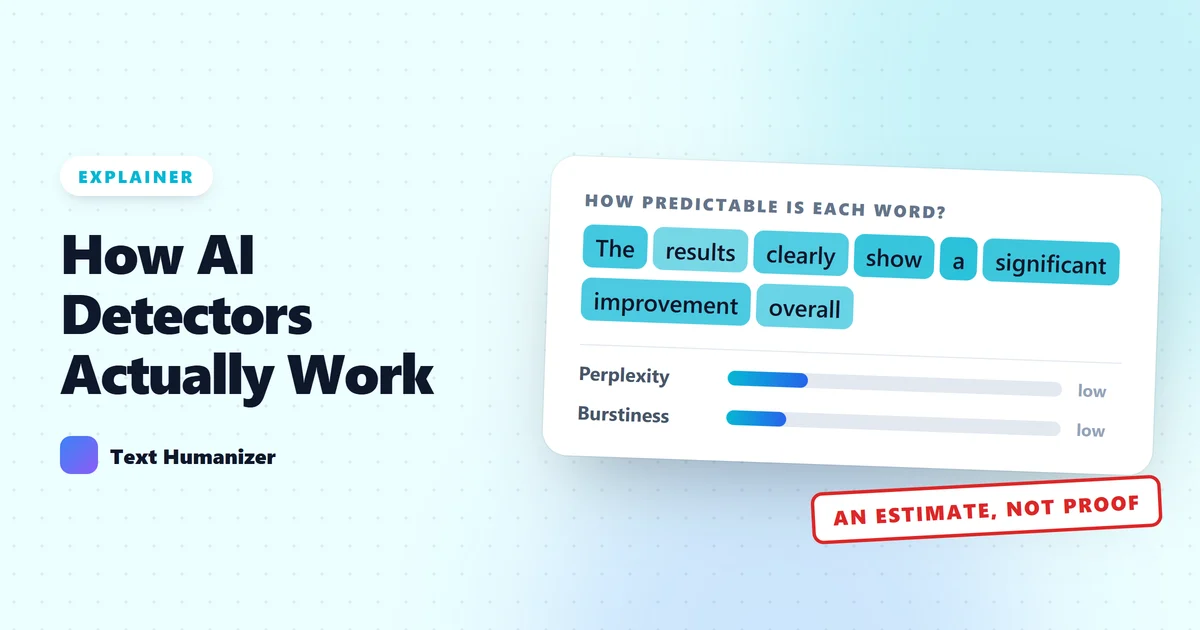
Every AI detector on the market is doing some version of the same thing: running your text through a model and asking how surprised that model is by your word choices. The tools differ in training data and thresholds, but the core mechanism — perplexity — is shared across nearly all of them.
Perplexity is a measure of predictability. If a language model can guess your next word correctly most of the time, your perplexity is low, which the detector interprets as a sign of AI authorship — because AI models, remember, are specifically built to choose likely words. If your word choices frequently surprise the model, your perplexity is high, which reads as more human, because genuine human writing deviates from statistical safety constantly, in small idiosyncratic ways.
The second major signal is burstiness, which looks at variation across a passage rather than word by word. A human writer naturally alternates between short and long sentences, simple and complex structures. AI text tends toward a comfortable, consistent middle. Low burstiness paired with low perplexity is the strongest combined signal most detectors use to flag a passage as likely AI-generated.
Where detectors get it wrong
Beyond these two statistical measures, some detectors — Turnitin and Copyleaks among them — layer in pattern matching against known AI outputs and phrase databases, essentially checking whether your text resembles the specific outputs their training set has seen from GPT-family models, Claude, and others. This is why detector accuracy varies so much depending on which model generated the original text and how recently the detector was updated.
None of this is remotely foolproof, and detector companies will tell you as much if you read their documentation closely. False positives happen constantly, especially to non-native English speakers, whose writing patterns can trend toward the same measured, grammatically careful style that AI models produce — through a completely different, entirely human process of learning English as a second language. False negatives happen too: once AI text has been substantially edited, the statistical signals a detector relies on may no longer be there to measure.
What this means for you
This is the important part to understand if you are worried about a false accusation, or trying to make legitimately AI-assisted work read naturally: detectors are measuring statistical patterns, not truth. A detector cannot know who wrote something. It can only estimate how closely the text resembles known AI output patterns. That estimate can be wrong in both directions, which is exactly why responsible platforms — including this one — frame detector scores as one data point, never as proof.
The most durable way to produce text that reads as human, whether or not a detector ever looks at it, is the same advice writing teachers have given for decades: vary your sentences, choose specific words over safe ones, and put something of yourself into it. Writing like that is simply better writing, and it is the only approach that does not depend on what any particular tool happens to measure this year.
Try the Free AI Humanizer
See the difference genuine humanizing makes — paste any AI text and get natural, human-sounding writing back.
Humanize My TextKeep reading
6 min read
How to Edit an AI Draft So It Sounds Like You: A 15-Minute Checklist
A practical, ordered checklist for turning a flat AI draft into something you would actually put your name on, with or without a tool.
5 min read
AI Humanizer vs. Paraphrasing Tool: What Is the Difference?
They sound similar and overlap in practice, but they are built for different jobs. Here is how to tell which one your draft actually needs.