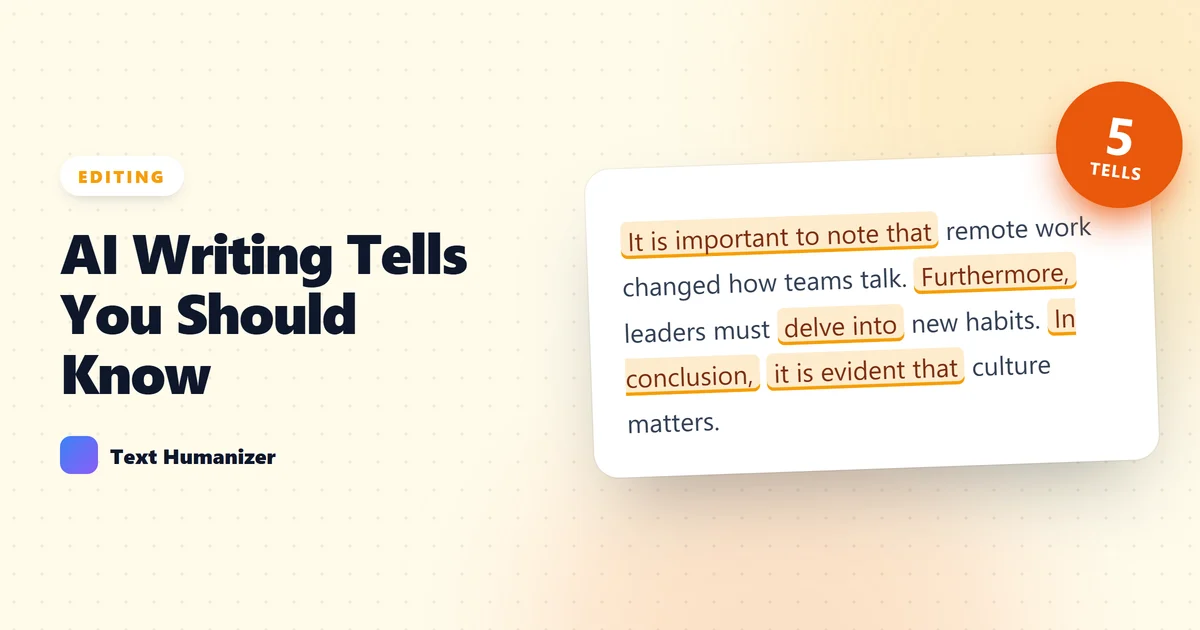
The seven tells
Every writing tool has tells, but AI models have unusually consistent ones — because millions of people are prompting the same handful of models with similar requests, and those models keep reaching for the same statistically safe patterns. If you know what to look for, you can spot AI writing almost on sight. More usefully, you can also go fix it in your own drafts before anyone else notices.
The most obvious tell is the throat-clearing opener. "It is important to note that," "It is worth mentioning," "One cannot overstate the significance of" — these phrases add zero information. They exist because the model needs to start a sentence somehow, and these openers are common enough in training data to feel statistically safe. A real writer with something to say just says it.
Second is the stacked formal connector: furthermore, moreover, additionally, in addition. Human writers use these occasionally, but AI text piles them up because each one is a low-risk way to glue two sentences together without doing the harder work of an actual transition. Cut them and often the sentences connect just fine on their own.
Third, and maybe the most infamous, is "delve." Nobody says "let's delve into this" out loud. It became an AI signature phrase almost by accident — a word that was common enough in formal writing to be statistically likely, rare enough in casual writing that its overuse stands out immediately once you notice it.
Fourth is the tidy rule-of-three list inside a sentence: "faster, cheaper, and more efficient," always exactly three items, always in ascending or parallel structure. Real thinking is messier than that. People list two things, or five, or one big thing with a caveat.
Fifth is the summary that restates the introduction almost word for word: "In conclusion, it is clear that X is important because of Y and Z" — where Y and Z are literally the same points made three paragraphs earlier, just reworded. A human conclusion usually adds something: an implication, a next step, a lingering question.
Sixth is uniform paragraph length. Every paragraph runs four to five sentences, no more, no less, like a formula. Human writing paragraphs when the idea runs out, not when a counter hits five.
Seventh, and the hardest to fix by hand, is the flat emotional register. AI text discusses a product launch and a natural disaster in roughly the same measured tone. People's writing shifts — gets terser under stress, looser when excited, warmer when personal. Restoring that requires actually caring about what you are writing, which is either the easiest fix on this list or the hardest, depending on how you look at it.
Try the Free AI Humanizer
See the difference genuine humanizing makes — paste any AI text and get natural, human-sounding writing back.
Humanize My TextKeep reading
6 min read
How AI Detectors Actually Work (And Why None of Them Are Perfect)
GPTZero, Turnitin, Copyleaks — they all claim to spot AI text, but the underlying method is more statistical guesswork than certainty. Here is what is actually happening.
6 min read
How to Edit an AI Draft So It Sounds Like You: A 15-Minute Checklist
A practical, ordered checklist for turning a flat AI draft into something you would actually put your name on, with or without a tool.