Most people who write for school or work now use AI somewhere in the process, and most of the anxiety around it comes from not knowing where the line is. There is no single line. Rules differ between institutions, between courses in the same institution, and between employers. What follows is a way to think about it that holds up under most of those rules, plus the questions to ask when you are unsure.
What is generally fine, and what is not
Start with the policy, not the tool. Before you use AI on an assignment or a client deliverable, find out what has actually been said. A syllabus may ban it, allow it for brainstorming only, or allow it with disclosure. An employer may restrict it because of confidentiality rather than authorship. If nothing is written down, ask. A one-line question to an instructor or manager is cheaper than any misunderstanding later.
Uses that are widely accepted tend to share one feature: the thinking is still yours. Asking for an outline you then rework, getting an explanation of a concept you then verify, checking grammar, tightening a paragraph you wrote, or rewording a stiff sentence are all forms of help people have long received from editors, tutors and software.
Disclose, and verify everything
Uses that cause trouble also share a feature: they hand in work as yours when the substance is not. Submitting a generated essay on a topic you have not engaged with, presenting generated analysis as your own reasoning, or inventing sources fall on the wrong side almost everywhere. So does pasting confidential material into a tool your employer has not approved.
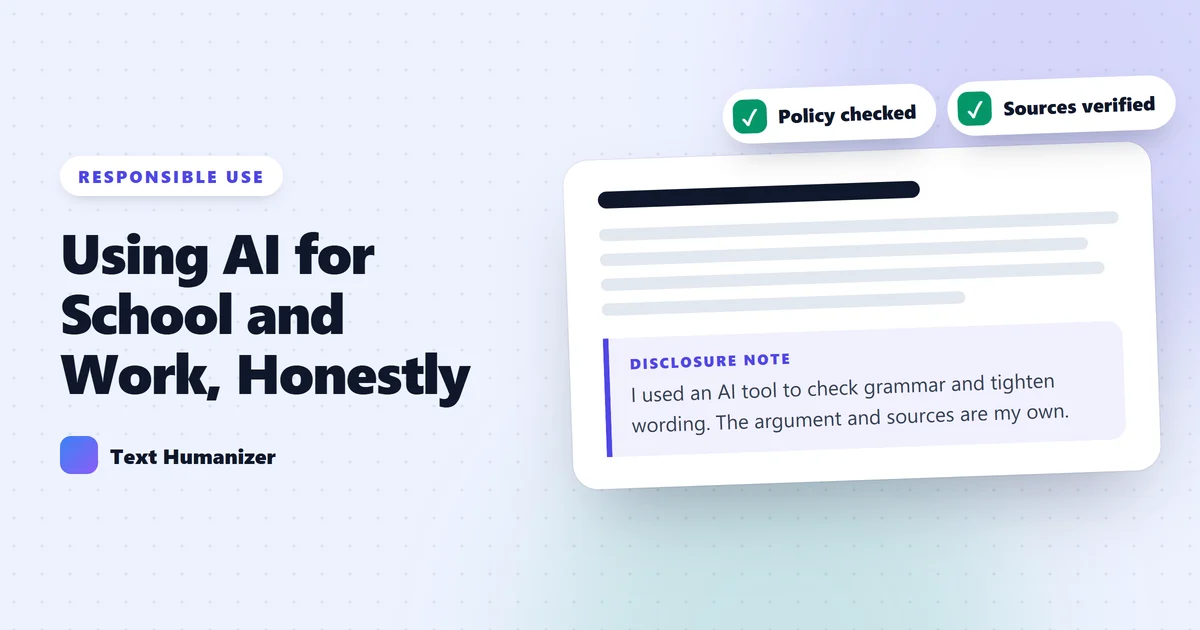
Disclosure solves more than people expect. Where AI help is allowed, a short note covers you: which tool you used and for what. "I used an AI tool to check grammar and tighten wording; the argument and sources are my own" is honest, takes ten seconds and removes the question entirely. If you find yourself reluctant to write that sentence, that reluctance is useful information about whether the use was appropriate.
Where editing tools fit
Always verify. Language models produce confident text, not checked facts. Every statistic, quotation, date and reference in an AI-assisted draft needs to be confirmed against a real source you have opened yourself. Fabricated citations are the single most common way AI use goes wrong, and they are entirely avoidable.
Where do rewriting tools fit? A humanizer or grammar checker improves how your text reads. That is editing, and it is appropriate for the same things editing has always been appropriate for: making your own ideas clearer. It does not change who did the thinking, and it is not a way around a rule that asks you to disclose or avoid AI. Detection tools, for their part, are estimates that can be wrong in both directions, which is one more reason to rely on being able to explain and show your process rather than on any score.
A simple test to finish with: could you explain the piece, defend its claims and describe how you produced it, to the person who will read it? If yes, you are almost certainly fine. If not, the fix is not better wording. It is doing more of the work yourself.
Try the Free AI Humanizer
See the difference genuine humanizing makes — paste any AI text and get natural, human-sounding writing back.
Humanize My TextKeep reading
5 min read
Why AI Writing Sounds Robotic (And How to Actually Fix It)
AI can draft a paragraph in seconds, but readers can usually tell. Here's the actual reason AI text feels stiff — and what fixing it really requires.
4 min read
7 AI Writing Habits That Give You Away Instantly
Certain phrases and patterns show up in AI writing so often they have become dead giveaways. Here is the full list, and why each one happens.